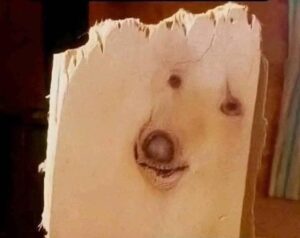
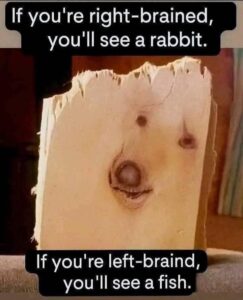
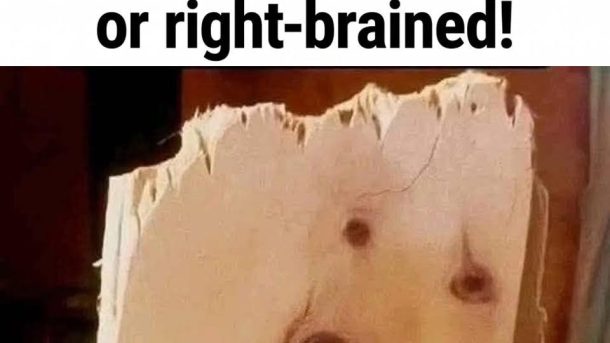
Which animal do you see first? Rabbit? Fish?

Hey there, fellow brain explorers! Have you ever wondered why some people are wizards with words and numbers, while others seem to spin magic out of nothing but

We have all heard the chatter about being “left-brained” (the analytical math geniuses) or “right-brained” (the moody, brilliant artists). But is there really such a strict divide inside our heads? Today, we aren’t going to get all serious with boring science books. We’re going to do something way more fun!

Take a close look at the weird, wooden, kind of crunchy-looking piece of stuff in the picture below.

Seriously, just glance at it for a few seconds. Don’t overthink it. Which animal shape popped out to greet your eyes first? Did you see a quick little rabbit? A mysterious floating fish? Or… did you see something entirely different?

Let’s find out what your visual instinct says about your unique flavor of brainpower!

1. The Right-Brained Whiz: You Saw a Rabbit First
If you saw a rabbit first, you are likely part of the “right-brained whiz” club! Congratulations! People whose right hemisphere is dominant are often the big-picture thinkers. You look at a collection of random lines and cracks, and your brain doesn’t just see “cracks”—it sees connections. It instantly synthesizes the information into a whole, recognizable creature.

What this says about you: You are probably intuitive and spontaneous. You prefer flowing with the energy of a project rather than following a rigid map. You love storytelling, music, or art, and you get gut feelings that are remarkably accurate. You don’t need a spreadsheet to tell you what to do next; you just feel it.

2. The Left-Brained Logic: You Saw a Fish First
Did a sleek fish swim into your mind first? Then you are a champion of left-brained thinking! You are the organized, sequential superstar who keeps the world spinning on schedule.

What this says about you: You don’t get easily distracted by shiny objects—or fuzzy rabbit ears. You notice the small stuff. Your brain quickly analyzed the shapes: a mouth-like notch at the bottom, an eye-spot, the jagged edge that looks like a tail fin. You pieced the evidence together logically. You prefer clear instructions, bullet points, and facts you can double-check. While the right-brain is dreaming, you are the one getting the work done!

3. The Whole-Brained Maverick: You Saw a Dog First

Wait… a dog? Yes! If you saw a dog first (and most people who see a golden retriever puppy’s face tilting its head think you’re correct), you are a whole-brained maverick! You refuse to be categorized by some simple left-or-right theory.

What this says about you: You have a unique ability to use both sides of your brain simultaneously. You are analytical enough to see the texture, but creative enough to ignore the original context (a piece of wood or toast). You possess a balanced, flexible perspective. You can crunch the numbers but also dream up the vision. Basically, you are the flexible superhero the rest of us need!


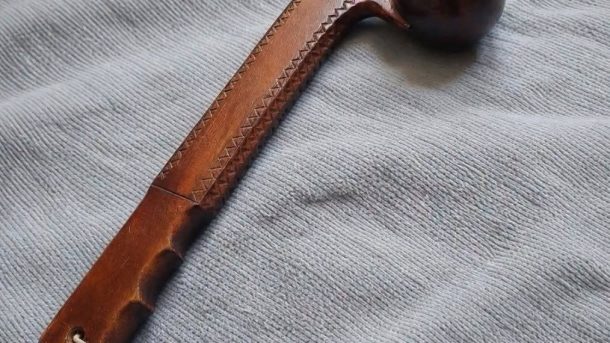
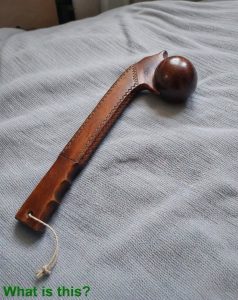
My friend and I came across this mysterious object — do you know what it might be?


He walked into the antique shop expecting nothing more than dusty shelves, forgotten objects, and the occasional curiosity.

Then he noticed it.

A small, surprisingly heavy piece of metal, barely ten centimeters long, with an unusual circular pattern engraved into its center.

The shopkeeper couldn’t identify it.

That only made it more intriguing.

For less than five euros, he bought the mysterious object and carried it home, unaware that he had just purchased a piece of technology from another era.

For days, he searched online.

He tried different descriptions. He compared photographs. He browsed forums and antique references, hoping someone could tell him what the strange metal device was designed to do.
Nothing matched.

The object remained on his desk, quietly turning into a personal mystery.

Then, weeks later, an ordinary home repair produced an extraordinary result.

While working nearby, he accidentally struck the metal with a hammer.

The response was immediate.

A piercing, deafening sound suddenly filled the room.

He froze.

For a moment, there was only confusion. Then came the realization that the strange object wasn’t simply an antique ornament.

It was an old alarm mechanism.

Somehow, despite sitting forgotten for decades, it still worked.

The discovery transformed the little piece of metal from a five-euro curiosity into something far more fascinating: a forgotten device that had survived its original surroundings and remained capable of performing the job it had been designed to do.

What appeared to be a meaningless object on a dusty shelf had been waiting all those years for the right—or perhaps wrong—moment to reveal its secret.

Sometimes the most remarkable discoveries don’t begin with a treasure map or a museum expedition.

Sometimes they begin with an unidentifiable object, a curious mind, and one very unfortunate swing of a hammer.

What Does “WC” Actually Mean on Restroom Signs

You have likely seen it countless times—on a hotel door in Paris, a train station in Rome, or an older building in your own city:
WC
Most people recognize it as a symbol for “restroom” or “bathroom.” Yet surprisingly, many have never paused to wonder what those two letters actually stand for. And once you learn the answer, it clicks into place with a quiet sense of satisfaction.
What Does “WC” Stand For?
WC stands for Water Closet.
It is an older term, originally used to describe a small, enclosed room containing a flush toilet. Simple, descriptive, and practical—much like the invention it named.
Why Was It Called a “Water Closet”?
In the 19th century, indoor plumbing was a revolutionary convenience. Before modern bathrooms became standard:
Toilets were often located outdoors, in separate outbuildings
Bathing and washing typically happened in different rooms
Privacy and sanitation were handled in distinct spaces
When homes and public buildings began installing indoor flush toilets, these compact, dedicated rooms were naturally called water closets: a small, closet-like space housing a toilet that used water to flush waste away. The name was literal, functional, and clear.

Why Do So Many Places Still Use “WC” Today?
Though the term may sound old-fashioned to modern ears, it remains widely used around the world—particularly in international settings. You will often see WC on signage in:
European countries
Hotels and hostels

European countries
Hotels and hostels
Airports and train stations
Historic buildings and tourist destinations
Its endurance is no accident. “WC” is short, language-neutral, and easily understood across cultures. In a world of diverse tongues, it functions as a quiet universal symbol.
Why Not Just Say “Bathroom”?
Language is regional, and terms for the same space vary widely:
Bathroom: Common in North America; implies a room with both a toilet and a bath or shower
Restroom: Frequently used in U.S. public spaces; emphasizes comfort and privacy
Toilet: Direct and common in the UK, Europe, and many other regions
WC: International, concise, and widely recognized on signage
Each term reflects cultural norms, historical usage, and practical communication needs. None is inherently “correct”—they simply serve different contexts.

A Small Window into Language Evolution
Terms like “Water Closet” illustrate how language shifts over time. What once sounded modern and precise can become historical, yet persist in everyday life through habit, tradition, or utility. This kind of linguistic drift—where words outlive their original context but retain functional value—is a core subject of study in historical linguistics.

How Many Chairs Are Really There?

How Many Chairs Are Really There?

Have you ever looked at a picture and felt your brain doing a double-take?

That is exactly what happens when you stare at this viral visual riddle.

At first glance, it looks like a simple drawing of a wooden table and some chairs.

But the more you look at it, the more confusing it becomes.

The big question written at the top asks: “How many chairs are really there?”

It sounds like a simple math question, but everyone seems to find a different number.

Let’s break it down together, step by step, and look at all the clues.

The First Impression: What Our Eyes See Immediately
When you first open the image, you probably see a standard dining setup.

There is a wooden table right in the center of the picture.

Around the table, there are regular-sized wooden chairs with curved backs.

On the left side, there is one chair placed further back and another one closer to us.

On the right side, there is another chair placed near the front.

Behind the table, there appears to be another chair standing in the background.

And then, things get a little bit weird.

Right on top of the table, there is a tiny, miniature version of the exact same chair.

Finally, on the far right side of the image, there is a large standing mirror.

Inside that mirror, we can see a reflection of a chair with the tiny chair on top of it.

If you just count everything you see without thinking, your brain might give you a quick number.

But this is a riddle, which means there is a catch.

The Clues and the Confusion: Looking Closer
To find the real answer, we have to become detectives and look for things that do not make sense.

Let’s look at the mirror on the right side.

A mirror always shows a reflection of what is actually happening in the real world in front of it.

In the mirror, we see a regular chair, and on its seat, there is a tiny chair.

Now, look at the table in the real world.

The tiny chair is sitting right on top of the wooden table.

But look at the chair behind the table.

The back of that chair aligns perfectly with the tiny chair on the table.

In fact, if you look very closely, the tiny chair looks like it is resting exactly where the seat of that back chair should be.

Could it be that the chair behind the table isn’t actually a full-sized chair in the background?

Or maybe the tiny chair on the table isn’t on the table at all?

This is where the optical illusion plays tricks on our depth perception.

The artist drew this image in a way that forces our eyes to see two different things at the same time.

Analyzing the Logical Possibilities
Because this is a drawing and not a real photograph, we can solve it using a few different logical theories.

Let’s explore the most popular ways to answer this riddle.

Theory 1: The Optical Illusion Trick

The first theory is the most popular one online because it treats the image like a true puzzle.

Look at the mirror reflection very carefully.

The mirror shows a large chair with a tiny chair sitting directly on its seat.

But if you look at the actual table, there is no large chair in front of the mirror.

Instead, the tiny chair is on the table, and the top of a chair is behind the table.

This means the “chair behind the table” and the “tiny chair on the table” might actually be just ONE single chair.

Under this smart theory, the answer is actually four.

Theory 2: The Total Visual Approach (The Maximum Count)

The third way to solve this is to take everything literally and count every single chair element drawn by the artist.

Let’s count the actual physical objects drawn in the room and inside the mirror.

We have the two chairs on the left side.

We have the one chair in the front right.

We have the chair in the back.

And we have the tiny miniature chair on top of the table.

Finally, we look inside the mirror itself.

The mirror shows a large chair, and on top of that large chair, there is another tiny chair.

If you believe your eyes and count every individual chair shape drawn on this canvas, the number grows.

The Final Verdict: What is the Best Answer?
So, after looking at all the evidence, how many chairs are really there?

The most logical and literal answer for anyone looking at this entire picture is 7 chairs.

Here is the final breakdown of why seven is the best answer:

There are 2 chairs clearly sitting on the left side.

There is 1 chair clearly sitting on the front right side.

There is 1 chair standing behind the table.

There is 1 tiny chair sitting on top of the table.

There is 1 large chair reflected inside the mirror.

There is 1 tiny chair reflected on top of the mirror chair.

How Many Hidden Faces Can You See in This Picture?

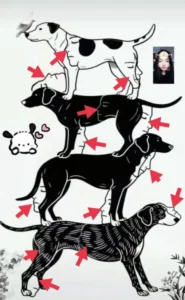
How many human faces can YOU find hidden in this image?

Don’t rush.
This puzzle is designed to confuse your perception. If you stare too quickly, your brain automatically groups everything back into dog shapes.

Try looking from different angles.
Focus on the empty spaces.
Ignore the dogs for a moment and search only for facial outlines.

⏳ You have 20 seconds to count every hidden face.

Ready?

Most people think this is just a drawing of dogs.

That’s exactly why this illusion is so effective.

The artist secretly hid multiple human faces inside the image, blending them into the dogs so naturally that your brain keeps overlooking them. Some faces are formed by shadows, some by body outlines, and others only appear when you stop focusing on the dogs themselves.

The strange part?

Once you spot one hidden face, suddenly more begin appearing everywhere.

People online keep arguing about the real number because almost nobody sees the same amount on their first try. Some claim there are 6 faces. Others swear there are more.

Now it’s your turn to test your eyes.

Start now.

…
..
.

So… what number did you end up with?

And more importantly — are you sure you didn’t miss one hiding in plain sight?

Here is the answer:

How Many Eggs Do You See?

Here’s a simple-looking question that can be surprisingly tricky:

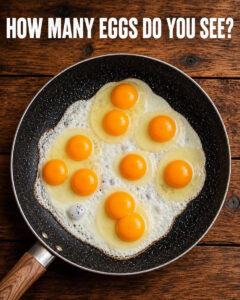
How many eggs do you see in this picture?

At first glance, the answer may seem obvious. You can see several bright yellow egg yolks spread across the pan, and most of them are easy to spot. But before you give your answer, take a few seconds to look carefully.

Don’t just count the yellow circles quickly. Look at how the eggs are arranged, especially where some of them are close together or overlapping.

You might come up with 6 eggs, 9 eggs, or even 10 eggs. So which answer makes the most sense?

Let’s take a closer look.

Could the answer be 6?

Some people may answer 6 because they count only the most obvious eggs at first.

When we look at a busy picture, our eyes sometimes group things together. The egg whites are spread across the pan, and several yolks are positioned quite close to one another.

For example, the two yolks near the bottom are touching, and the three yolks on the left and center can also make the picture look more crowded than it really is.

If you count too quickly, you might accidentally treat some of the eggs as part of the same group rather than counting each yolk separately.

So 6 is possible as a quick guess, but it doesn’t hold up very well when we carefully count each visible yolk.

Could there be 10 eggs?

Now let’s consider the opposite idea.

Maybe there are 10 eggs, with one egg hidden underneath another egg or covered by the egg whites.

This is an interesting possibility because the eggs are not perfectly separated. Some of the whites overlap, and two yolks at the bottom are touching each other.

Could there be another yolk hiding somewhere?

It’s possible to imagine one, but there is an important problem: we need some visible evidence for it.

If we cannot clearly see another yolk or another separate egg, counting it would be based on imagination rather than what is actually shown in the picture.

So 10 is an interesting possibility, but there isn’t enough evidence to support it.

So, is the answer 9?

The two at the bottom are especially easy to overlook because they are touching. They might look like one large yolk at first, but when you look closely, you can clearly see two separate yolks.

And that’s probably the main trick of this puzzle.

Final Answer

So, after considering all three possibilities, the most logical answer is: 9 eggs!

There are nine clearly visible yolks in the pan.

The answer 6 comes from counting too quickly, while 10 requires us to assume that another egg is hidden without any clear evidence.

The safest rule for visual puzzles like this is simple: count what you can actually see, not what you think might be hiding.

So, how many did you see on your first try?

Lady Gaga Begins a New Chapter as She Welcomes Her First Baby

Lady Gaga has entered a deeply personal new chapter of her life, welcoming her first baby and giving fans another reason to celebrate alongside her.

Known around the world for her music, performances and unmistakable personality, Gaga has spent much of her life in the public eye. But moments involving family and private life have always carried a different kind of meaning for the superstar.

The news has quickly attracted attention from fans who have followed Gaga throughout her extraordinary career. For many, seeing the singer step into motherhood represents a completely new chapter beyond the stage and spotlight.

Gaga has built a career filled with major achievements, from chart-topping music to unforgettable performances and acclaimed acting roles. Yet becoming a mother is a milestone that exists outside the awards, headlines and entertainment industry.

Fans have flooded social media with messages of congratulations and warm wishes for Gaga and her family. The reaction shows just how strongly audiences connect with celebrities not only as performers, but also as people experiencing the same major life moments as everyone else.

For Gaga, this moment comes after years of intense public attention and an extraordinary career. Motherhood now adds an entirely different dimension to her story.

While fans will undoubtedly continue to follow her career, this moment is ultimately about family, love and a new beginning.

For millions of people who have watched Lady Gaga’s journey, one thing is certain: this is a chapter they will remember.

❤️ Congratulations to Lady Gaga and her family on this beautiful new beginning.

I Raised My Triplet Nieces for 22 Years Then Their College Graduation Revealed the Note Their Father Left Behind

Diana answered on the second ring.

For several long seconds, Noah couldn’t manage a single word. Twelve years had passed since they had truly been part of each other’s lives — twelve years of silence, missed opportunities, half-finished conversations that trailed off before either of them said the thing that actually mattered, phone numbers saved and never dialed, birthdays remembered and never acknowledged.

“Hello?” Diana finally said, her voice carrying that same warm, slightly amused patience he remembered from more than a decade earlier, as if she’d been expecting this call for years and had simply been waiting for him to catch up.

Noah closed his eyes, gripping the phone a little too tightly. “It’s me.”

Another pause stretched out between them, not uncomfortable exactly, just full, the way silence gets when two people are both quietly recalibrating an entire decade in real time.

Then Diana said, simply, “I know.”

A faint smile tugged at the corner of Noah’s mouth despite everything churning in his chest. Of course she knew. Some voices stayed with you no matter how much time and distance you tried to put between yourself and them.

He stood beside the window of his apartment, watching the evening traffic crawl below, red taillights stacking up at the corner light the way they did every night around this hour. “I didn’t know if I should call.”

“You always say that right before doing something important,” Diana replied, and he could hear, even through the phone, the smile in her voice.

For the first time in days — maybe longer, if he was honest with himself — Noah laughed. A real laugh, the kind that comes from somewhere lower in your chest than the polite, performed kind he’d been giving people all week.

Then Diana asked the question he’d known was coming from the moment he dialed. “How are they?”

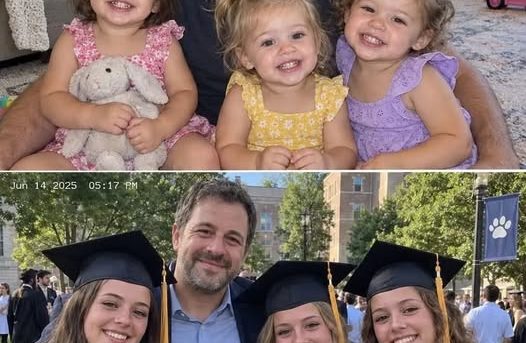
Noah’s eyes drifted to the framed photograph sitting on his desk, the one he’d looked at probably forty times that day already without meaning to. Three young women stood beside him in graduation gowns, their caps slightly askew from laughing too hard right before the photo was taken. Their smiles were nearly identical, the way triplets’ smiles tend to be to anyone who doesn’t know them intimately, but Noah could see, instantly and without effort, all the small differences everyone else missed.

“They graduated last week,” he said.

“I know. I saw the pictures online.”

Noah swallowed hard. “They’re not little girls anymore.”

“No,” Diana said gently, and there was something tender underneath the simplicity of the words. “They aren’t.”

Twenty-two years. That was how long Noah had spent building an entire life around three people who had not existed in his world at all until one terrible November morning, and now, suddenly, impossibly, they didn’t need him in the way they once had, and he had absolutely no idea what to do with the space that left behind.

“I thought I would feel happier than this,” he admitted quietly.

“Why would you feel happy?”

“Because I finally have my life back.”

Diana didn’t answer right away. Noah kept staring at the photograph, at three faces that had once been small enough to fit against his chest, one at a time, while he paced a dark apartment at three in the morning trying to get someone to stop crying.

“The problem is,” he whispered, finally, “I don’t actually know what my life is anymore.”

To understand exactly why that question had so completely stumped a fifty-three-year-old man, you’d have to go back twenty-two years, to the cold November morning when the entire shape of Noah Carter’s life changed in the span of a single phone call.

At thirty-one, Noah’s life had been ordinary in the best possible sense of the word. Not exciting, not particularly remarkable to anyone watching from the outside, but entirely his own. He had a steady job at a regional logistics company, the kind of work that paid reliably without ever asking too much of his evenings. A small one-bedroom apartment he’d furnished slowly, piece by piece, over a couple of years. A used pickup truck with a hundred and ten thousand miles on it that he babied like it owed him money. Modest, unhurried plans for the future — save enough for a down payment on a house eventually, take a real vacation somewhere with mountains instead of another long weekend visiting relatives, maybe, someday, meet someone, get married, have kids of his own on whatever timeline felt right.

There was no urgency to any of it. He genuinely believed, the way most people in their early thirties believe, that he had plenty of time to figure the rest out.

Then, one cold November morning, his older sister Emily called. Or at least, Noah thought it was Emily, because her name lit up his phone screen exactly the way it always did.

When he answered, all he heard at first was crying — not Emily’s crying, he’d later understand, but the sound of the phone being held by someone standing near her.

“Emily?”

No response. Just the crying, distant and muffled, and then a man’s voice, steady and professionally careful in a way that immediately made Noah’s stomach drop before the man had said anything substantial at all.

“Are you Noah Carter?”

“Yes.”

“This is the hospital. We’re calling regarding your sister, Emily.”

There had been an accident. Emily and her husband, Mark, had been driving home from a late dinner when another vehicle, driven by someone who’d later be found to have a blood alcohol level nearly three times the legal limit, crossed the center line on a stretch of two-lane highway they drove almost every single week. Mark died at the scene, before the paramedics had even fully arrived. Emily made it to the hospital alive, technically, but she never regained consciousness.

Noah spent hours sitting beside her hospital bed that night, holding her hand, talking to her as though she could hear every word, telling her about nothing in particular — the weather, a movie he’d seen recently, an argument he’d had with a coworker about scheduling that suddenly seemed so absurdly small it embarrassed him to have even mentioned it out loud to his dying sister.

He told her she would be okay. He told himself the exact same thing, over and over, like a prayer he wasn’t entirely sure he believed in but needed to say anyway.

Eventually, a doctor came into the room, and Noah understood from the particular careful arrangement of the man’s face, before he’d said a single word, that there would be no version of this story with a happy ending. Emily’s condition was deteriorating rapidly. The injuries to her brain were, the doctor explained in language that felt simultaneously too technical and too gentle, incompatible with any meaningful recovery.

Then came the second reality Noah could barely process, layered on top of the first before he’d had even a moment to absorb it.

Emily had three infant daughters. Triplets, born just eight months earlier after a pregnancy that had terrified and thrilled her in equal measure, that Noah remembered her describing over the phone with a kind of giddy disbelief. Emma, Lily, and Grace. Three tiny girls who, within the span of a single night, had lost both their parents at once.

A social worker eventually found Noah sitting alone in the hospital hallway sometime after two in the morning, his eyes raw, his hands still faintly smelling of the hand sanitizer from Emily’s room.

“We need to discuss temporary arrangements for the children,” she said gently, sitting down in the chair beside him.

Noah looked through the wide nursery window down the hall, at three small bassinets arranged in a row, three impossibly small bundles inside them, entirely unaware of what had just happened to the entire architecture of their lives.

“I’m their uncle,” he said.

“Yes, we have that on file.”

“I’ll take them.”

The social worker studied him carefully for a long moment, her expression not unkind but professionally assessing. Noah was unmarried. He lived alone in a one-bedroom apartment barely large enough for one adult and a modest amount of furniture. He worked full time, forty-five, sometimes fifty hours a week depending on the season. He had never raised a child in his life, let alone three infants simultaneously. And he was, in that exact moment, sitting in a hospital hallway grieving the sudden, violent loss of his only sibling.

“You don’t have to decide tonight,” she told him softly.

“Yes, I do.”

“Why do you feel that way?”

Noah looked back through the glass at the nursery. Three babies lay inside, tiny and swaddled and entirely oblivious, waiting for someone, anyone, to decide what happened to them next.

“Because they’re waiting for someone to choose them,” he said.

That decision took him only seconds to make, standing there in a hospital corridor that smelled like antiseptic and bad coffee. Living with the full weight of that decision would shape the next twenty-two years of his life, in ways he couldn’t have possibly imagined that night, sitting in a molded plastic chair with his sister dying two rooms away.

The first night alone with all three girls in his apartment was, in a word, chaos.

Noah quickly discovered that babies apparently possessed some kind of uncanny, almost supernatural ability to coordinate their crying schedules with military precision. One would wake, hungry or wet or simply needing to be held, and within minutes, as though summoned by some invisible signal, the second would join in. Then, inevitably, right as he’d finally gotten the first two settled, the third would start.

He moved through his small apartment for hours that night carrying bottles, diapers, blankets, wearing the permanently exhausted, slightly panicked expression of a man who had absolutely no idea what he was doing but was determined not to let three infants figure that out. He barely slept at all — an hour here, forty minutes there, always interrupted before his body had any real chance to settle.

The following morning, running on fumes and terror, he called his boss.

“I need some time off,” he said, standing in his kitchen surrounded by three cribs he’d borrowed from three different coworkers who’d heard about his situation through the office grapevine faster than he could have explained it himself.

“How much time?” his boss asked.

“I don’t know,” Noah admitted honestly. “I genuinely don’t know yet.”

Two weeks turned, gradually and without any clean, single decision point, into a full month. Eventually Noah negotiated reduced hours with his company, taking a pay cut he could barely afford in order to buy himself the flexibility three infants required. His savings, the careful, disciplined nest egg he’d been building for years toward that eventual house, began disappearing at a rate that genuinely frightened him some nights when he sat down to do the math.

Everything, he discovered quickly, came in threes when you were raising triplets. Formula, purchased in cases rather than single cans. Diapers, an endless, bottomless expense that seemed to multiply faster than he could track. Three sets of clothes, since the girls, despite being triplets, grew at slightly different rates and couldn’t simply share a single wardrobe the way he’d naively assumed they might. Triple the doctor visits. Triple the emergencies, and there were more emergencies than he’d ever anticipated — fevers that spiked in the middle of the night, a case of croup that sent him racing to the emergency room with Grace wrapped in a blanket while a neighbor watched Emma and Lily, the ordinary, relentless small catastrophes of raising infants that nobody had adequately warned him about.

But the money frightened him considerably less than the deeper fear sitting underneath all of it. What if he missed something important? What if one of them got seriously sick and he simply didn’t know the right thing to do, didn’t recognize the warning signs a more experienced parent would have caught instantly? What if, at the end of all of it, he simply wasn’t enough for what these three girls actually needed?

Late at night, once all three of them had finally, mercifully fallen asleep, Noah sometimes sat on the floor beside their cribs and cried quietly, his back against the wall, exhaustion and grief and fear all tangled together into something he couldn’t fully separate anymore. Then he would look at their small, sleeping faces, and he would whisper the same four words, every single time.

“I’m still here.”

Night after night, for weeks, then months, he repeated them. Eventually, without his ever quite deciding it consciously, those four words became something closer to a promise, one he renewed almost nightly without ever writing it down or speaking it to another adult.

To outsiders, the triplets looked almost perfectly identical, the kind of resemblance that made strangers in grocery stores stop and stare, that made even close family friends occasionally mix up their names. To Noah, though, they became unmistakably, distinctly different from each other with a speed that surprised him.

Emma had a small, crescent-shaped birthmark near her left shoulder, barely visible unless you were looking for it, and she grew, from her earliest months, into the most cautious of the three — the one who checked twice before crossing anything, who read the instructions before assembling anything, who worried out loud about consequences the other two barely considered.

Lily curled her fingers into loose fists while she slept, a habit that never fully went away even into her teenage years, and she became, almost from the moment she could crawl, fearless, stubborn, and relentlessly determined in a way that occasionally terrified Noah and occasionally made him laugh out loud with pride, sometimes within the same five minutes.

Grace had a tiny crease that appeared beside her right eye whenever she smiled, and she seemed able, even as a toddler, to sense other people’s emotions before anyone else in the room did — the first to notice when Noah had had a hard day, the first to climb into his lap wordlessly on nights he didn’t yet know he needed it.

Noah learned, gradually and through considerable trial and error, that raising triplets was nothing at all like simply doing the same parenting job three separate times. They wanted different things. They feared different things — Emma was terrified of thunderstorms well into elementary school, Lily was afraid of almost nothing at all except, oddly, buttons, and Grace worried, from a young age, about whether other people were sad, sometimes more than she worried about herself.

They reacted differently to disappointment, and like most siblings anywhere in the world, they constantly, relentlessly compared themselves against one another. Why was Lily better at math? Why could Emma stay up later than the other two before getting cranky? Why did Grace seem to make friends so effortlessly at every new school, every summer camp, every situation that made the other two anxious?

Noah became, over those early years, whatever the moment specifically required of him. Cook. Nurse. Referee, more times than he could count, settling disputes over toys and turns and who got the good spot on the couch. Driver, eventually, once car seats and then booster seats and then, much later, actual driving lessons entered the picture. Homework assistant, even in subjects he’d barely passed himself in school. Disciplinarian, a role he never grew fully comfortable with but learned to occupy anyway. Cheerleader at soccer games and school plays and science fairs. Storyteller at bedtime, inventing increasingly elaborate tales because the girls, individually and collectively, demanded new material faster than he could reasonably produce it. Handyman, fixing bicycles and broken toys and, later, the increasingly complex technology problems three teenage girls generated with alarming regularity.

He wasn’t perfect at any of it. He burned dinners, missed the occasional school event because of work conflicts he couldn’t avoid, said the wrong thing more times than he wanted to remember. But every single morning, he got up and tried again, which turned out, he’d eventually come to understand, to matter considerably more than getting everything right the first time.

When the girls were six years old, a question arrived that Noah had been quietly dreading for months, the kind of question he’d rehearsed answers to in his head during long, sleepless nights without ever feeling fully prepared for the actual moment.

They were sitting together on the living room floor one rainy Saturday afternoon, looking through an old family photo album Noah had been meaning to put away somewhere less accessible, when Grace pointed at a photograph of a young, smiling woman holding three newborns.

“Uncle Noah,” she asked, her small finger still pressed against the photo, “why don’t we live with Mommy?”

Noah froze completely, his whole body going still. He’d known this moment was coming eventually. He simply hadn’t expected it to arrive on an ordinary rainy Saturday, with all three of them still in their pajamas.

He sat down carefully on the floor beside them, arranging himself so he could see all three faces at once. “She died,” he said gently, “when you were still babies. Too little to remember her.”

Lily looked confused, her small brow furrowing. “And Daddy?”

“He died too. The same day.”

A heavy silence filled the room, the kind that felt enormous coming from three small children who didn’t yet have the vocabulary for what they were feeling.

Emma eventually looked up at him, her expression serious in a way that seemed older than six. “Then who takes care of us?”

“I do.”
Florida Priest Faces More Than $500,000 in Fines for Feeding the Homeless — But He Refuses to Stop

For 36 years, a Florida priest has made helping people in need part of his life.

Father Bob Caudill has continued feeding homeless people in his community despite a long-running dispute with the city and fines that have reportedly grown to more than $500,000.

The conflict began after the city rezoned the area where the meals were being provided in 2014. Since then, the fines have continued to accumulate.

But Caudill says the penalties will not change what he believes is his responsibility.

For him, feeding someone who is hungry is more important than the money involved.

His story has sparked a larger conversation about homelessness, compassion and how communities should respond when people are struggling.

After decades of serving those in need, Caudill says he has no intention of stopping.

“I will never stop.”

For many people, the story is a reminder that sometimes helping others comes with a cost — but compassion can be worth far more than money. ❤️

10-year-old girl on e-bike dies, her brother critically injured after hit-and-run crash in Miami-Dade, MDSO says

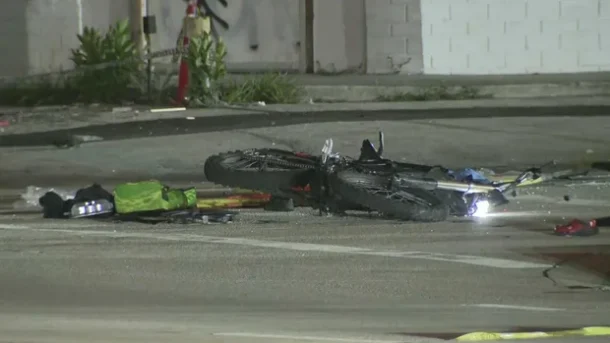
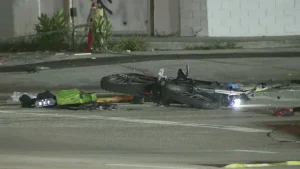
aAn investigation is underway in Northwest Miami-Dade after deputies say a 10-year-old girl was killed, and a boy was critically injured when a hit-and-run driver crashed into them while they were riding an e-bike on Wednesday night.

According to information provided to CBS News Miami, the Miami-Dade Sheriff’s Office said deputies responded to reports of the hit-and-run crash in the area of Northwest 117th Street and Northwest 7th Avenue around 8:40 p.m.

When deputies arrived at the scene, they said they found the victims, a boy and a girl, lying in the middle of the road and were unresponsive.

A hit-and-run driver crashed into a boy and girl who were riding an e-bike in Northwest Miami-Dade on Wednesday, Sept, 9, 2026, the MDSO said.

Members of Miami-Dade Fire Rescue responded to the scene and rushed the victims to a Miami hospital, where the girl later died. The boy, who the family says is the girl’s older brother, had been listed in critical condition as of Thursday.

The Gwen Cherry Bulls, a local youth organization, identified the girl as Peyton, describing her as a cheerleader. “It is with profound sadness and a heavy heart that we share the news of a devastating loss within our community,” the organization said. “Last night, we lost a beautiful angel, our beloved cheerleader, Peyton.”

A friend of the boy said the two had been riding together earlier in the day before the boy went home.

“It’s sad, because you can just be riding with someone and then something happens so quickly,” said JahJah, identified as a bike rider who knew the children.

According to the preliminary investigation, deputies said the driver was headed north on Northwest 7th Avenue and made a left onto Northwest 117th Street and hit the two victims while they were riding an e-bike.

Neighbor Jeannette Lange said she saw a large police presence near her front door and was upset about the incident.

“With kids, man, this is very bad,” Lange said. “I think police should find the people who did that. You know that’s not fair. That’s not fair.”

The Gwen Cherry Bulls organization shared photos and video of Peyton with CBS News Miami.

A 10-year-old girl, identified by her family as Peyton, was killed after her and her brother were struck by a car while riding an e-bike in northwest Miami-Dade. The driver is still at large, according to MDSO.  Gwen Cherry Bulls

Meanwhile, friends and family continue to add to a growing memorial at the crash site, leaving flowers, stuffed animals and balloons to honor the children. The memorial now includes a billboard truck as well.

“I feel like it isn’t real. Why her out of all people?” said Peyton’s cousin, Willow Gabriel. Gabriel spoke to CBS News Miami on Saturday with permission from her family. She came with other family members to the memorial.

“I feel bad for everyone out here because we’re not supposed to be out here,” Willow said. “They did them wrong. They did them dirty.”

A neighbor named Wade said he saw the aftermath of the incident.

“Just a lot of people in shock. And people said ‘call 911’. It was real tough to see,” he said.

Gabriel and the rest of the family urged the suspect to come forward. So did Wade, the neighbor.

“You gonna live with guilt for the rest of your life. You don’t wanna live with guilt. The right thing to do is be honest so the family can have closure,” Wade said.

The Miami-Dade Sheriff’s Office said that as of Friday, they are still searching for the vehicle that struck the children and fled the scene.

Deputies said they were searching for a 2009-2012 Nissan Versa that’s silver or grey in color.

The MDSO Traffic Homicide Unit has since taken over the investigation, and anyone with information about the fatal incident should call Miami-Dade Crime Stoppers at 305-471-TIPS (8477).

If a tip is received and it leads to the arrest of a suspect or suspects, the tipster may be eligible for a reward of up to $5,000, the MDSO said.


credits https://www.cbsnews.com/