Doctors reveal that drinking coffee every morning causes… See more

The cup that wakes you up might also be quietly wearing you down.
Every sip can sharpen your focus—while slowly training your body not to function without it.
Doctors are now warning that your harmless “morning ritual” may be fueling anxiety, wrecking your sleep, and rewiring your brain’s reward system in ways you never expe… Continues…

What begins as a comforting ritual can gradually turn into a dependency you hardly notice. That first cup lifts the fog, but over time your brain adapts, demanding more caffeine just to feel “normal.” When you skip it, the withdrawal speaks loudly: pounding headaches, irritability, exhaustion, and a strange sense that the day simply can’t begin. This isn’t just habit; it’s your nervous system recalibrated around a drug.

Doctors aren’t calling for everyone to quit coffee, but they are urging respect for its power. Limiting yourself to 2–3 cups, avoiding it on an empty stomach, and cutting off caffeine later in the day can protect your sleep, your mood, and your digestion. The goal isn’t to lose the comfort of your morning mug, but to reclaim the feeling that you, not the coffee, are in control.
Australian rock icon Gary “Angry” Anderson dies at 79

The stage lights went dark far too soon.
Fans expected an encore. Instead, they got a goodbye. Gary “Angry” Anderson, the ferocious voice of Rose Tattoo, died at 79 after collapsing mid–farewell tour, leaving a silence no amplifier can fix. Behind the tattoos and snarls was a father, a fighter, a vulnerab… Continues…

Gary “Angry” Anderson’s life was built on defiance. Born in Melbourne in 1947, he grew from scrappy “Angry Ant” to the thunderous frontman of Rose Tattoo, a band that had to leave Australia for the UK before their homeland finally embraced them. With anthems like “Bad Boy for Love,” “Rock ’n’ Roll Outlaw,” “Nice Boys,” and “We Can’t Be Beaten,” Anderson gave voice to outsiders who refused to bow.

Yet beneath the noise, he was known as a devoted father and fiercely loyal friend. His ballad “Suddenly” revealed a softer core, soundtracking one of TV’s most iconic weddings on Neighbours, while his turn in Mad Max Beyond Thunderdome showed how easily he could dominate a screen as well as a stage. When he died on September 21, surrounded by loved ones, it wasn’t just a rock singer Australia lost, but a piece of its raw, unvarnished soul.

They Promised Peaceful Green Burials. What Federal Agents Found Inside This Colorado Funeral Home Shocked the World!

Families thought they were burying their dead with dignity. Instead, they unknowingly funded a grotesque empire of rot, lies, and luxury. In a quiet Colorado town, a “green” funeral home became a secret morgue of decay, fraud, and shattered trust. When the smell finally forced the doors open, what investigators uncovered was so vile, so cold-bloo… Continues…

What happened inside the Return to Nature Funeral Home was not a mistake, but a chilling betrayal carried out in slow motion. Jon and Carie Hallford sold themselves as gentle guides through grief, using the language of “eco-friendly” compassion while quietly discarding the very humanity of those in their care. As bodies decomposed in hidden rooms, they spent freely on designer luxuries, vacations, and cosmetic treatments, converting sorrow into a personal ATM.

For the families, the second loss was often worse than the first. They had already endured funerals, scattered ashes, whispered prayers over urns they cradled like something sacred. Then came the phone calls, the DNA tests, the realization that their goodbyes were built on a lie. No sentence can restore the stolen years of false closure, but their outrage has reshaped Colorado law, tightening oversight so others may never endure this same, unthinkable violation of trust.

HT17. COVID-19 vaccinated individuals may be ill…See more

The warning signs were always there.
But no one knew what they meant.
Now, researchers say they’ve finally uncovered a hidden molecular trigger that could explain rare cases of heart inflammation after mRNA COVID-19 shots—and the story is far more complicated, and unsettling, than anyone expected. Inside lab dishes and animal hearts, a pair of immune signals lit up like flar… Continues…

Scientists examining mRNA COVID-19 vaccines have zeroed in on two immune signaling proteins, CXCL10 and interferon-gamma, as possible drivers of the rare myocarditis cases seen mostly in young men. In experimental models, certain immune cells exposed to vaccine components began releasing these signals, setting off inflammatory cascades capable of affecting heart tissue. When researchers blocked those signals, markers of heart damage dropped, yet the broader protective immune response against the virus largely remained intact.

This delicate balance is the heart of the story: understanding how to preserve strong vaccine protection while dialing down the tiny fraction of harmful reactions. The authors stress that the overall risk of myocarditis after vaccination is very low, and that COVID-19 infection itself is more likely to injure the heart. Early hints that compounds such as genistein might blunt inflammation are intriguing, but far from ready for clinical use. For now, the findings offer something crucial: a plausible mechanism, and a path to safer next-generation vaccines.

ABC Anchor Admits Truth As Trump’s DC Crackdown Yields Big Results

Washington didn’t see this coming. One order, one signature, and the city’s soul went up for grabs. Sirens, boots, unmarked cars, and a silence that felt like a warning. Crime fell fast. Fear fell slower. ICE vans circled schools, bus stops, corner stores. Families stopped answering knocks. Now the capital of American democracy is asking whether “law and order” just means la… Continues…

Donald Trump’s decision to federalize Washington, D.C., did what years of press conferences and pilot programs could not: it made the streets feel different in a matter of days. Some residents describe it as the first time in years they’ve walked home without clutching keys between their fingers, the first week their group chats weren’t just links to surveillance videos and police reports. They see the armored vehicles and joint task forces as overdue proof that someone in power finally took their fear seriously.

But on the same blocks, other residents have started memorizing license plates and escape routes. Parents rehearse what to say if an agent follows them from the playground. Local officers quietly admit they no longer know who’s really in charge on a call. What began as a crackdown on crime has become a stress test for democracy itself, forcing Washington to confront whether security built on terror can ever truly be called safe.

THEY THOUGHT SHE WAS HELPLESS UNTIL SHE FOUGHT BACK THE SHOCKING ATM AMBUSH OF A SEVENTY SEVEN YEAR OLD GRANDMOTHER WHO REFUSED TO SURRENDER

The first man never saw the elbow coming. The second didn’t expect the roar that followed. By the time the third realized the “frail” pensioner wasn’t breaking, the street had already turned against them. This wasn’t just a robbery attempt; it was a brutal miscalculation about age, fear, and power. Winifred’s response changed everyth… Continues…

Winifred’s defiance didn’t come from training, but from a lifetime of refusing to be diminished. In those few seconds at the ATM, she chose rage over resignation, presence over paralysis. Her elbow, her grip on the card, and that unyielding shout were all declarations: you don’t get to decide that I am weak. As onlookers rushed in and the attackers fled empty-handed, the narrative of who is “vulnerable” on the street quietly cracked.

In the days that followed, Winifred’s story spread far beyond that cold metal machine. Neighbors began watching out for one another; shopkeepers and police coordinated more closely. Yet the most profound shift was invisible: people started to see elders not as passive victims, but as survivors with deep reserves of strength. Winifred didn’t ask to be a symbol, but she became one—of boundaries defended, dignity preserved, and courage that refuses to retire.

BREAKING: Karoline Leavitt confirms President’s new health battle…

The truth landed like a thunderclap. Donald Trump, in the middle of a brutal election season, is suddenly facing a health condition no one saw coming. His team insists his heart is fine. Supporters flood the internet with desperate prayers. Critics whisper, rivals calculate. One diagnosis, and the illusion of invincibility shatters befo… Continues…

The revelation of chronic venous insufficiency forces a rare pause in a campaign built on relentless motion and defiance. Swelling, discomfort, the need to slow down—these are not just medical notes, but political tremors. Every careful step off a rally stage, every visible moment of fatigue will now be studied, replayed, and weaponized in a race where perception is everything.

Yet beneath the noise, a quieter story emerges: a 78-year-old man pushing his body through a schedule that would strain someone half his age, refusing to show weakness in a country obsessed with strength. For supporters, this is a call to rally tighter. For opponents, a sign of vulnerability. For everyone else, it is a stark reminder that even the most polarizing figures bleed, age, and hurt like anyone else—and must decide how much of that truth to let the world see.

He Returned It 132 Years Late — Then the Library Revealed the $12,055 Surprise

Imagine finding an old library item in your home and discovering that it should have been returned more than a century ago.

That is exactly what happened in New Hampshire, where a September 1894 issue of The Century Illustrated Monthly Magazine finally made its way back to the Concord Public Library.

The magazine was an astonishing 48,220 days overdue — roughly 132 years.

The man who returned it, John Hanson, said the historic magazine had been in his home for decades, but he did not know exactly how it had ended up there or who had originally borrowed it.

Then came the number that made the unusual return even more remarkable.

Based on the library’s calculation, the overdue charge would have reached an estimated $12,055.

But Hanson didn’t have to pay it.

The timing of the return happened to coincide with Concord Public Library’s temporary freeze on overdue fines. The program was introduced to encourage people to bring back long-overdue library materials without worrying about accumulated penalties.

Library staff had expected the program might bring back some forgotten books and other materials. They weren’t expecting something dating all the way back to the 19th century.

The magazine itself is now a historical object. Instead of simply putting it back on a shelf for someone else to borrow, the library plans to preserve it and may display it as part of its historical collection.

More than a century after it left the library, its extraordinarily long journey has finally come to an end.

And perhaps the most surprising part of the story?

After 132 years and a theoretical $12,055 overdue bill, the final amount due was $0.

The Groom’s Family Demanded A DNA Test For The Newborn – The Medical Result Shocked Them All

When two white parents gave birth to a dark-skinned baby, the husband’s family immediately accused the wife of infidelity and demanded a DNA test. The results caused a massive shock: he was 100% the biological father. Doctors discovered it was an incredibly rare genetic anomaly where hidden dormant genes from generations past surfaced, proving the mother’s innocence and completely stunning the family.

At First Glance, It Looked Like A Shocking Growth On His Finger – But The Truth Behind This Spiky “Anomaly” Is Entirely Natural

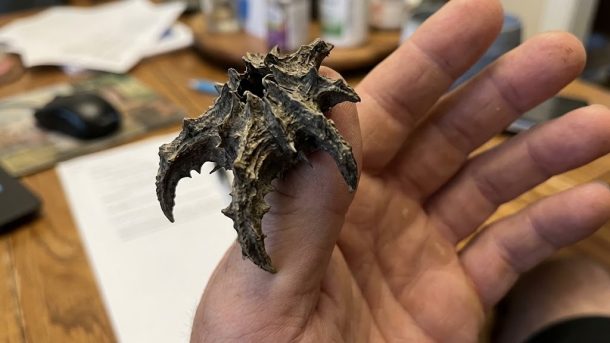
When this photo first began circulating online, it immediately made people stop and stare. Resting on a man’s thumb is what appears to be a spiky, dark, and almost prehistoric-looking growth. With its sharp, claw-like ridges and hollow center, it looks like something straight out of a sci-fi movie—or a severe, terrifying biological anomaly.

Social media was quick to speculate. Some guessed it was a rare parasite, others feared it was a bizarre infection, and many urged the person to go to a hospital immediately. At first glance, it really does look like an aggressive, spiked deformity fused to the skin.

However, despite its intimidating and almost alien appearance, the truth is entirely harmless.

This bizarre, spiky object is not part of the hand at all. It is actually a dried seed pod from a plant, often known as the “Devil’s Claw” (from the Martynia or Proboscidea family) or a similar thorny natural burr.

hese plants have evolved to grow incredibly tough, woody seed pods with sharp, curved hooks. In nature, their frightening shape serves a very practical purpose: the hooks are designed to catch onto the fur of passing animals (or the footwear of humans) so the plant can hitchhike and scatter its seeds across new territory.

When placed casually on the thumb, the natural curves of the seed pod perfectly mimic a monstrous, spiky “claw,” creating a brilliant optical illusion that has fooled thousands of people. It’s a perfect reminder of how wild, strange, and occasionally deceptive the natural world can be!